By Dunya Maumoon
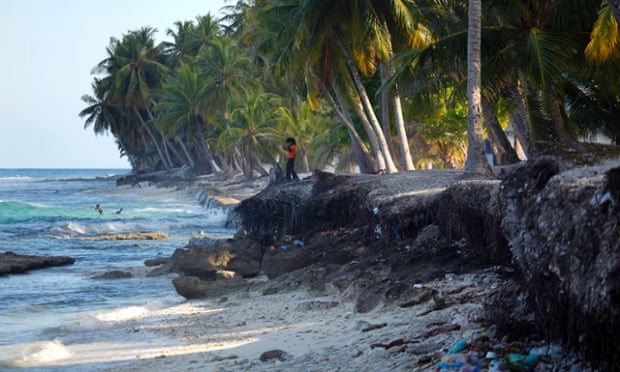
Island states, such as the Maldives, are already making ambitious changes to adapt to rising sea levels. With a global resolve to implement such solutions, it could be possible to tackle the climate impasse.
Sunday, February 1, 2015
Wednesday, December 31, 2014
Experimental Climate Monitoring and Prediction for Maldives – December 2014
HIGHLIGHTS
Above average rainfall was observed in southern
islands of Maldives where up to 190 mm rainfall was observed at
the end of November and this is the highest rainfall observed in
this year in any part of the country. The rest of the country
received below average rainfall during November. Very heavy
rainfall is expected in the sea west of Maldives in the next few
days. Most of ENSO prediction models indicate a weak El Nino
condition during December to February.
![]() |
| Rainfall Anomaly over Maldives in November 2014. Areas in green received above average rainfall while areas in brown received below average rainfall. |
---------------------------Inside this Issue------------------------
- Monthly Climatology
- Rainfall Monitoring
- Daily Satellite derived Rainfall Estimates
- Monthly Rainfall derived from Satellite Rainfall Estimate
- Monthly and Seasonal Monitoring
- Ocean Surface Monitoring
- Rainfall Predictions
- Weekly Predictions from NOAA/NCEP
- Seasonal Predictions from IRI
Monday, December 1, 2014
Experimental Climate Monitoring and Prediction for Maldives – November 2014
Highlights
Up to 100 mm rainfall was observed in Central to Northern islands of Maldives in the first three weeks of November 2014. Extremely heavy rainfall is expected to continue during the next week in the same region as well as in the north-eastern sea of The Maldives. Despite this heavy rainfall, the precipitation received has not been enough to shrink the rainfall deficit persisted for several months.
Image: Rainfall anomaly continues to grow in Northern islands of Maldives. The same is observed throughout the country
Friday, October 24, 2014
Experimental Climate Monitoring and Prediction for Maldives – October 2014
Highlights
Above average rainfall was observed in northern and southern islands of Maldives in September 2014. In central islands, below average rainfall was observed despite having up to 300 mm rainfall during the month. The rainfall deficit persists in the entire country even though around 300 mm of rainfall was observed in September and the first two weeks of October.
Image: Rainfall anomaly continues to grow in Northern islands of Maldives. The same is observed throughout the country
Friday, September 12, 2014
Experimental Climate Monitoring and Prediction for Maldives – September 2014
Highlights
The northern and central islands of the Maldives garnered their highest monthly rainfall in August for 2014. Despite this the cumulative deficit of rainfall continues to grow and currently the amount of this deficit has grown past 500 mm. In southern islands the deficit has become more significant.
Image: Rainfall anomaly in August 2014. This shows an above average rainfall in northern and central islands and a below average rainfall in the south.
Friday, August 22, 2014
Maldives’ economy hardest hit by climate change: Asian Development Bank
By Lucy Lovell
Climate change could cause annual economic losses of over 12% of the Maldives’ GDP by the end of this century, says a new Asian Development Bank (ADB)climate and economics report released today (August 19).
Thursday, August 21, 2014
Experimental Climate Monitoring and Prediction for Maldives – August 2014
Highlights
Dry conditions persisted during the July in the entirety of Maldives. Lower rainfall than the previous month was observed across the country. But during the next week NOAA predicts heavy rainfall in Maldives and this prediction has been made with a high confidence. Sustained El Nino conditions are expected towards the end of this year. The sea surface temperature around the country has also risen to more than 10 C.
Image: Rainfall anomaly in July 2014. Darker brown area show a total rainfall deficit up to 400 mm covering most of The Maldives.
Subscribe to:
Posts (Atom)


