Wednesday, June 19, 2013

Art Confronts Maldives’ Climate Change Controversy

Source: Inter Press Service News Agency


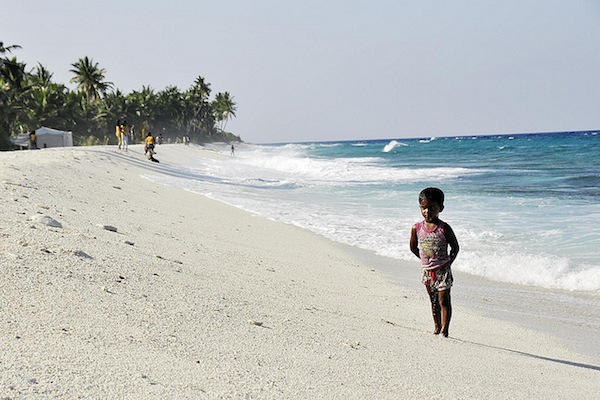
In the Maldives, a nation of small islands threatened by rising sea levels, the topic of climate change is a controversial one. Credit: Nattu/CC by 2.0
On the quay leading to the Arsenale exhibition complex, a block of ice melts in a rare blast of spring warmth. Elsewhere in the city, coconuts were bob on the choppy waters of the canals during the opening week of the 55th Venice Biennale.

Thursday, May 23, 2013

Experimental Climate Monitoring and Prediction for Maldives – May 2013

 Download Full Report

Highlights

The rainfall deficit over the Northern and Central islands continues to be in excess of 20% during the last 365 days. Recent rainfall events have mitigated this deficit slightly. In Southern islands, a surplus cumulative rainfall compared to the average of last 8 years was observed for the first time in this year. Highest observed rainfall for this year was observed during April/ May. In Southern Maldives this amount is the highest observed rainfall in these regions in the past 5 years. Seas around Maldives have also cooled down. A negatively anomalous sea surface temperature is observed instead of the positive anomaly which has persisted during the last couple of months.  


Image: Observed rainfall (Top) and Rainfall Deficit in South Maldives (Bottom)


Experimental Climate Monitoring and Prediction for Maldives – April 2013

 Download Full Report

Highlights

Drought conditions persist all over Maldives. South and central islands received relatively high rainfall compared to the previous months, but Northern islands received extremely less rainfall. Anomalous warm sea surface temperature is observed in the seas around Maldives. ENSO conditions remain in the neutral ENSO condition.   


Friday, April 26, 2013

Experimental Climate Monitoring and Prediction for Maldives – March 2013

 Download Full Report

Highlights

The cumulative rainfall of 20-40% deficit in in the past 365 days for Northern and Central Maldives highlights the drought conditions in the last two months, Southern Maldives too shows a deficit after having near normal rainfall in the previous 10 months. Although the El Nino/La Nina state in the Eastern tropical Pacific Ocean has been near-neutral the warm Central Indian Ocean sea surfaces are driving climate anomalies. In particular the seas around Northern and Southern are warmer than normally by up to 0.5 degrees C. Seasonal rainfall predictions for the next season (March-April-May) and following season (June-July-August) do not show shifts in rainfall tendencies, there is a higher likelihood of warmer temperatures across the Maldives.  


Image: SST Anomaly (Top) and Rainfall Deficit in South Maldives (Bottom)


Experimental Climate Monitoring and Prediction for Maldives – April 2013

 Download Full Report

Highlights

Drought conditions persist all over Maldives. South and central islands received relatively high rainfall compared to the previous months, but Northern islands received extremely less rainfall. Anomalous warm sea surface temperature is observed in the seas around Maldives. ENSO conditions remain in the neutral ENSO condition.  


Image: Observed rainfall in March 2013


Thursday, February 28, 2013

Experimental Climate Monitoring and Prediction for Maldives – February 2013

 Download Full Report

Highlights

As expected the rainfall was low for January particularly in the Northern Islands. Dry months are to follow. The cumulative deficit for the 365 days from the average ending in mid-February is highest in the Northern Islands, while being in deficit to some extent in the Central Islands but about normal in the Southern Islands.  


Image: Observed rainfall in December (top) and January (bottom)


Wednesday, January 23, 2013

Experimental Climate Monitoring and Prediction for Maldives – January 2013

 Download Full Report

Highlights

December 2012 has been a dry month for all of Maldives. The rainfall deficit compared to the last 8 year’s average has been growing for all Northern, Central and Southern islands of Maldives. Dry conditions are expected to be sustained during January. There is a higher than average chance of above normal precipitation in Central Maldives from February to April. The chances of above normal temperature, when the January to March period is taken in aggregate, is higher than normal throughout Maldives particularly in the Central Region.  


Image: Rainfall deficit (in brown) in Central Maldives