Wednesday, September 23, 2015

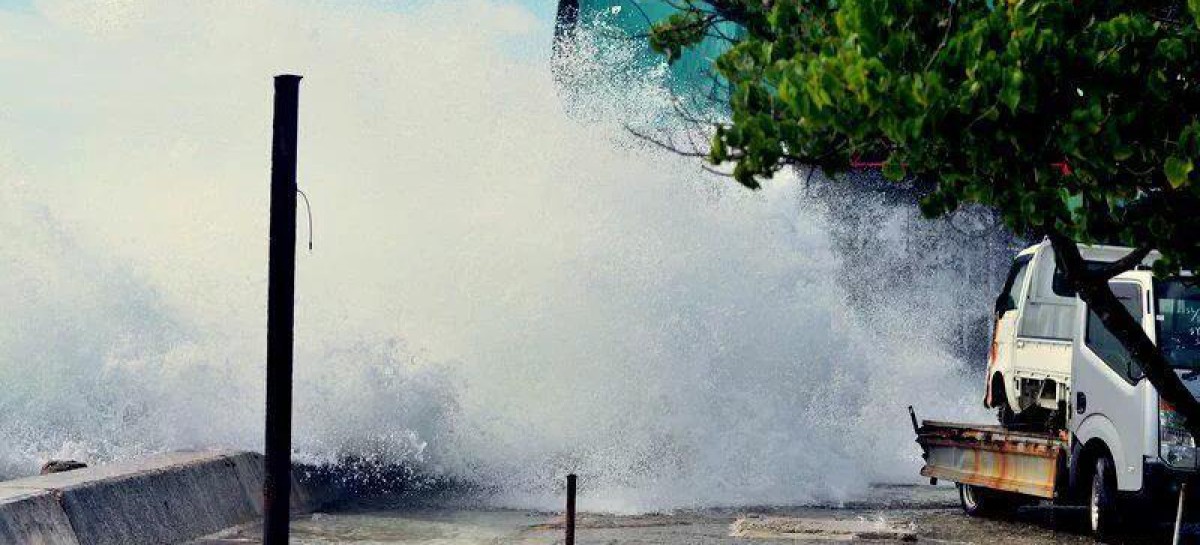
Tidal swells may cause flooding in the Maldives next week

by Zaheena Rasheed

Tidal swells may cause flooding across the Maldives on September 28, 29 and 30, the department of meteorology has said.
The alert was issued after the Indian National Center for Ocean Information Services (INCOIS) warned of tidal flooding for the Indian coastline next week in connection with the perigean spring tide.
A perigean spring tide or king tide occurs when the new or full moon coincides with the perigree of the moon—the point when the moon is closest to the Earth.
Flooding does not always occur when there is perigean spring tide, but it is likely when a storm strikes at the same time as a king tide.
The Maldives has been experiencing a prolonged bout of bad weather in recent weeks, an unusual occurrence for September.
Some 400 passengers were rescued at sea and thunderstorms have damaged property across the country. A seaplane and several speedboats docked at harbors had to be refloated.
In August tidal swells hit the capital city of Malé, causing severe flooding in the northeast side of the city. The area was inundated in more than two feet of water.
Colombo based Foundation for Environment, Climate and Technology (FECT) has predicted above average rainfall in the Maldives up to November due to the ongoing El Nino weather phenomenon.
There has been a marked increase in reports of weather-related damage to property this year.
Source: www.maldivesindependent.com

Wednesday, August 26, 2015

Experimental Climate Monitoring and Prediction for Maldives – August 2015

HIGHLIGHTS

Heavy rainfall was observed over the entire Maldives in July/ early-August 2015. This is the highest observed monthly rainfall this year. Due to this heavy rainfall the cumulative deficit of rainfall has come down to about 9% in northern islands and central islands and there is no deficit in southern islands. NOAA CFS models predict heavy rainfall in southern and central islands until the end of August while IRI seasonal predictions say that there shall be above average rainfall in the next 3 months with 80% probability. This is in keeping with what’s typical during an El Nino.

Deficit of rainfall (brown hatch) in southern islands of Maldives. High rainfall in  the first two weeks of August 2015 has diminished the gap between observed rainfall and  average rainfall.


 Printable Version of the Full Report (PDF)


---------------------------Inside this Issue------------------------

  1. Monthly Climatology
  2. Rainfall Monitoring
    1. Daily Satellite derived Rainfall Estimates
    2. Monthly Rainfall derived from Satellite Rainfall Estimate
    3. Monthly and Seasonal Monitoring
  3. Ocean Surface Monitoring
  4. Rainfall Predictions
    1. Weekly Predictions from NOAA/NCEP
    2. Seasonal Predictions from IRI

Monday, July 27, 2015

Experimental Climate Monitoring and Prediction for Maldives – July 2015

HIGHLIGHTS

There was heavy rainfall from 10th- 18th July up to 80 mm/day rainfall across the Maldives. The rainfall this July was the highest in the past 5 years in the northern islands. Still the cumulative deficit of rainfall for the last nine months remained at 30% of expected rainfall. There is a strong El Nino in place with the Eastern Equatorial Pacific Sea Surfaces warmed up as expected. That shall last for six months and as is typical. The sea around Maldives and Sri Lanka is about 1 degree Celsius higher than the average. There is a gradient in sea surface temperatures between the warmer Arabian Sea and neutral seas near Indonesia as is typical with an Indian Ocean Dipole. The implications for Maldives varies between the Northern, Central and Southern Islands when it comes to rainfall (see separate post on this) but there shall be consistent warmer than usual temperatures for the next six months.

Observed monthly rainfall in and around the Maldives in June 2015


 Printable Version of the Full Report (PDF)


---------------------------Inside this Issue------------------------

  1. Monthly Climatology
  2. Rainfall Monitoring
    1. Daily Satellite derived Rainfall Estimates
    2. Monthly Rainfall derived from Satellite Rainfall Estimate
    3. Monthly and Seasonal Monitoring
  3. Ocean Surface Monitoring
  4. Rainfall Predictions
    1. Weekly Predictions from NOAA/NCEP
    2. Seasonal Predictions from IRI

Wednesday, June 24, 2015

Experimental Climate Monitoring and Prediction for Maldives – June 2015

HIGHLIGHTS

In the last week of June and the first week of June high rainfall was observed in the entire Maldives and then a rapid decrease was observed. No rainfall was observed in the past week in any part of Maldives. High rainfall is expected in the Northern tip of Maldives particularly in the seat towards the Kerala Coast. IRI multi-model 3 month seasonal precipitation predictions point to a tendency to a less than average rainfall in southern-most islands of the country. Both the El Nino and Indian Ocean warm conditions are driving warmer seasonal temperatures.

Rainfall Anomaly in May 2015. Highly above average rainfall was observed in the sea east of Central and Northern islands.


 Printable Version of the Full Report (PDF)


---------------------------Inside this Issue------------------------

  1. Monthly Climatology
  2. Rainfall Monitoring
    1. Daily Satellite derived Rainfall Estimates
    2. Monthly Rainfall derived from Satellite Rainfall Estimate
    3. Monthly and Seasonal Monitoring
  3. Ocean Surface Monitoring
  4. Rainfall Predictions
    1. Weekly Predictions from NOAA/NCEP
    2. Seasonal Predictions from IRI

Monday, May 25, 2015

Experimental Climate Monitoring and Prediction for Maldives – May 2015

HIGHLIGHTS

In April 2015 less than average monthly rainfall was observed throughout the Maldives. Usually the rainfall is high in April and the relatively high rainfall in the first two weeks in northern and southern islands was not sufficient to put this above the long-term average. The first week of May saw more than 100 mm rainfall in northern and southern islands and low rainfall in the central islands. The cumulative deficit of rainfall for the past year shows about 25% below normal for the northern islands and close to normal for the southern and central islands. The NOAA CFS models predict up to 50 mm in the next few from 20-25th May. A clean El Nino has onset in the Maldives and this coupled with the warmer Indian Ocean shall lead to warmer months in the next six months. The Central and Northern Islands are likely to have a dry tendency for the next four months followed by a wet tendency from October to December.


Below average rainfall observed in the entire country in March 2015

 Printable Version of the Full Report (PDF)


---------------------------Inside this Issue------------------------

  1. Monthly Climatology
  2. Rainfall Monitoring
    1. Daily Satellite derived Rainfall Estimates
    2. Monthly Rainfall derived from Satellite Rainfall Estimate
    3. Monthly and Seasonal Monitoring
  3. Ocean Surface Monitoring
  4. Rainfall Predictions
    1. Weekly Predictions from NOAA/NCEP
    2. Seasonal Predictions from IRI

Wednesday, May 13, 2015

Internship Report of Mr. Yoosuf Ashraj at Renewable Energy Maldives

By Yoosuf Ashraj

Mr Yoosuf Ashraj at Hulhumale
View of  Male city from the Male Jetty


I travelled to the Maldives as an Intern from the Foundation for Environment, Climate and Technology (FECT) at Renewable Energy Maldives (REM). This internship was arranged by FECT for the-Masters in (Sustainable) Development Practice from the University of Peradeniya. Since one of the students pulled out during the last minute, I had the opportunity to join Mr. K. Wijeratne who was undertaking a separate internship. I undertook preparatory work before and after and visited Male from 15th to 21st April 2013.

Internship Report on the status of Fresh Water and the Environment in the Greater Male, Maldives, by Mr. K. Wijeratne at FECT

By: K. Wijeratne
Master of Development Practice, Department of Economics and Statistics, University of Peradeniya, Sri Lanka. 


Status of Waste disposal in Thilafushi Island


I undertook the three months internship of my Masters in Development Practice Degree, offered by the University of Peradeniya, Sri Lanka, at the Foundation for Environment, Climate and Technology (FECT), and I worked under the supervison of Dr. Lareef Zubair (Principal Scientist - Foundation of Environment and Climate Technology; & Visiting Lecturer - University of Peradeniya, Sri Lanka).